The Comforting Ritual
The boardroom has a rhythm. Every quarter, we walk in, plug in our laptops, and project a deck that brings a collective sigh of relief: The “Close-to-Green” Security Dashboard.
We show a retrospective of the last 90 days. We point to patched vulnerabilities. We show compliance checklists marked “Complete.” We show a stable heat map where risks have been managed down from “Critical” to “Low.”
The board asks the question that has haunted CISOs for decades: “Are we secure?”
This ritual is a dangerous illusion.
No matter how healthy the budget looks or how flawlessly the dashboards glow green, the answer has never been straightforward. We have learned to turn messy reality into neat metrics to provide comfort. But in the age of Agentic AI, this coping mechanism is broken.
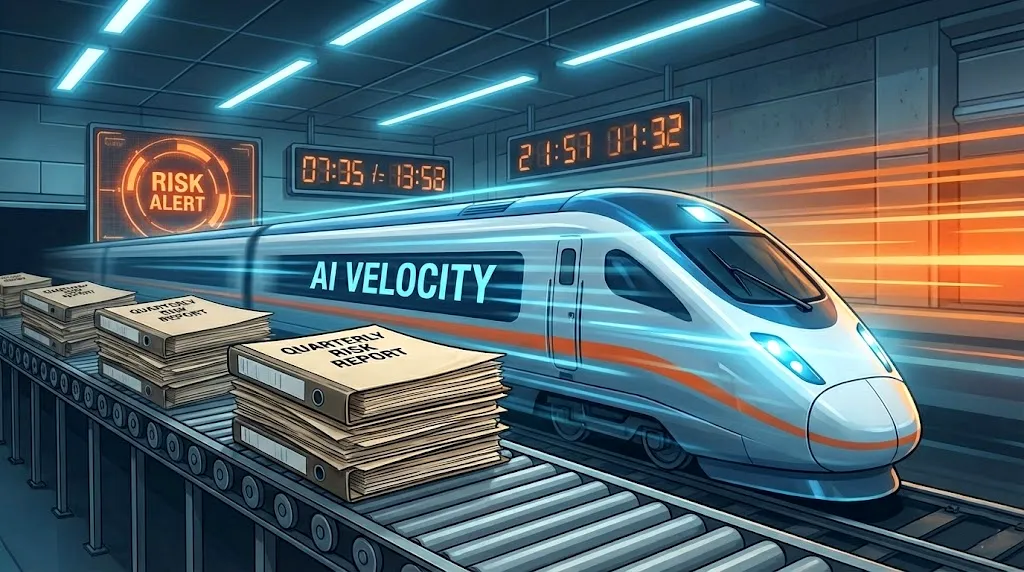
Relying on a quarterly retrospective to manage modern cyber risk is like trying to navigate a Formula 1 race using a hand-drawn map from three months ago.
The Asymmetry of Speed
- Then: Attackers spent weeks on reconnaissance and crafting spear-phishing emails.
- Now: AI agents scan your perimeter, identify zero-day drift, and generate hyper-personalized, context-aware phishing campaigns in seconds.
The status report isn’t a measure of security; it is a historical artifact. It tells the board where you were a month ago, not where you stand today. In a landscape defined by rapid change, it can create the illusion of control.
Even a “completed” remediation no longer reliably reflects current risk. The attack surface keeps expanding, dependencies shift, and severity evolves — constantly invalidating yesterday’s security posture.
The Enemy Within: The Shadow AI and Attack Surfaces Explosion
The velocity of external threats is terrifying, but for most CISOs, the more disruptive challenge isn’t coming from the outside—it’s coming from within.
Your business teams aren’t waiting for IT governance to catch up. Sales, Marketing, HR, and Engineering and other teams are already using AI for productivity and automation. Somewhere in your organization right now, someone is deploying an AI agent, or connecting to a third-party one, that you don’t know about yet.
This is Shadow IT at a scale we’ve never seen.
AI changes the geometry of the attack surface entirely. Every AI tool introduced—by your teams or your vendors—becomes a potential vector. AI agents are interacting directly with live data and real systems. These agents have overly-permissive access. They take various actions as designed or unexpected. And in many cases, nobody has mapped what they can touch.
We have moved from a bounded attack surface (endpoints, apps, cloud) to an exponential one.
The Data Quality Crisis
Beneath the velocity and the shadow usage lies a silent crisis: Data Quality.
AI amplifies the weaknesses in your data. Enterprise search and AI assistants pull information from everywhere—internal wikis, old Jira tickets, chat messages, which are not authoritative sources of content. If your data is incomplete, outdated, or poorly governed, AI doesn’t just expose that weakness; it weaponizes it.
An AI agent acting on “hallucinated” or outdated data isn’t just a glitch; it’s a business risk. Yet, the quality and provenance of the information feeding these systems rarely gets board-level airtime.
The Binary Lie: “Are We Secure?”
The instinct is to lock it all down. But we cannot block our way to safety. The business won’t accept it, and it wouldn’t solve the problem.
The first step to surviving the AI era is admitting that our current metrics—patched CVEs, compliance audits, and static heatmaps—are measuring the wrong things. We are measuring the silence while the storm gathers speed.
The question “Are we secure?” implies a binary state that has never existed. It drives boards to overbuy the illusion of prevention and underinvest in what actually matters: Resilience.
In Part 2 of this series, we will explore the strategic pivot: How to move the board’s mindset from “Protection” to “Adaptability,” and why the most important metric isn’t how many attacks you stopped, but how fast you can recover when the inevitable happens.